

Menu
Workplace safety
OSHA recordkeeping: how Forms 300, 300A, and 301 work together
A practical overview of the Log, annual Summary, Incident Report, posting, retention, and electronic-submission distinctions.
- For
- U.S. employers evaluating OSHA recordkeeping
- Scope
- Federal OSHA · confirm state-plan rules
- Approx. reading time
- 6-minute read
- Reviewed
- October 25, 2026
Use this guide when: understanding how Forms 300, 300A, and 301 work together or preparing to assess recordkeeping, posting, and electronic-submission responsibilities.
Content details
Content ID GUIDE-SAFE-001 · Version 1.4 · Next scheduled review January 20, 2027.
Estimated at 200 words per minute, rounded up. Optional examples and linked sources take extra time. Editorial review confirms structure, source linkage, clarity, and stated boundaries. It is not legal, tax, or other professional review.
Start here
What do you need to do?
On this page
The plain-language answer
Urgent reporting, routine case recording, annual posting, electronic submission, and retention are separate controls.
- Form 300: the running log of recordable cases.
- Form 301: case-level incident information.
- Form 300A: the certified annual summary used for required posting.
Electronic submission through OSHA’s Injury Tracking Application is a separate step for covered establishments.
What you need before starting
- The company’s peak employee count during the previous calendar year, each establishment’s relevant employee count and industry classification, location, and federal or state-plan jurisdiction.
- The minimum incident and medical or work-status facts needed for the decision; avoid unnecessary collection.
- The current OSHA forms or a permitted equivalent recordkeeping system.
- Owners for urgent reporting, recordability, restricted privacy-case handling, annual certification, posting, electronic submission, and retention.
See how the forms connect
One case can feed three different records
The forms are related, but they do different jobs. Use current OSHA files or a permitted equivalent system and protect identifying and medical information.
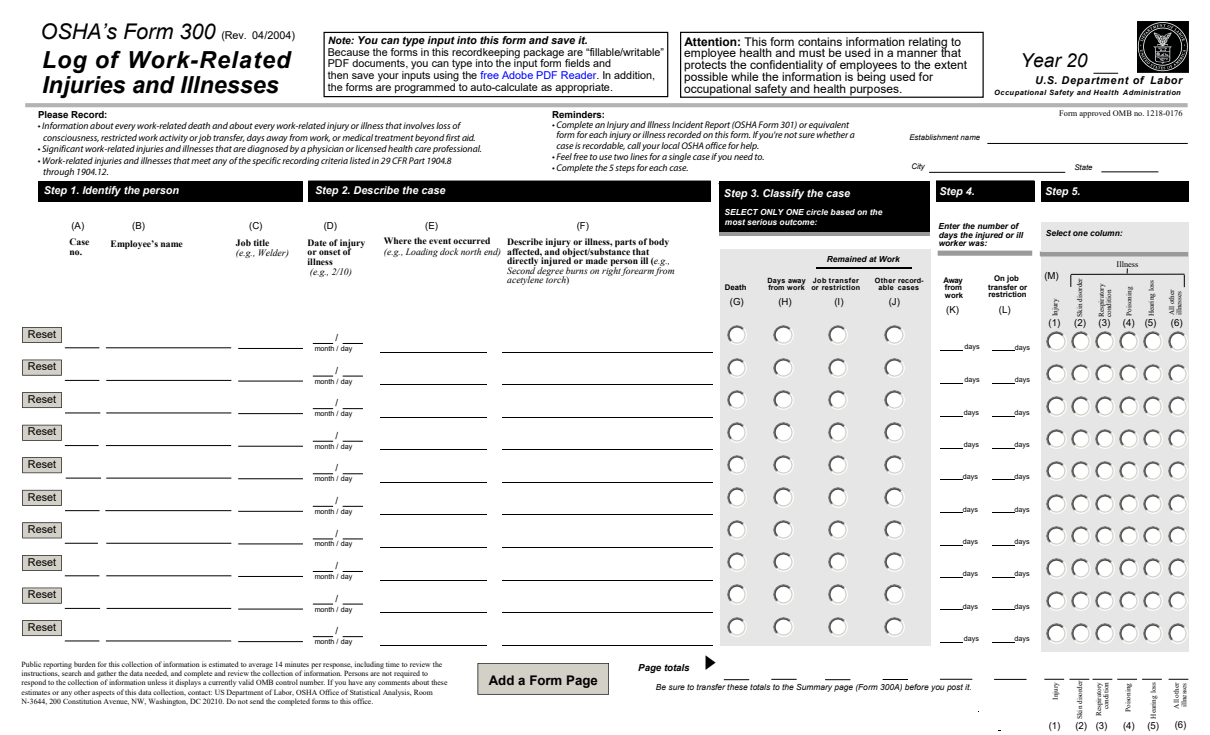
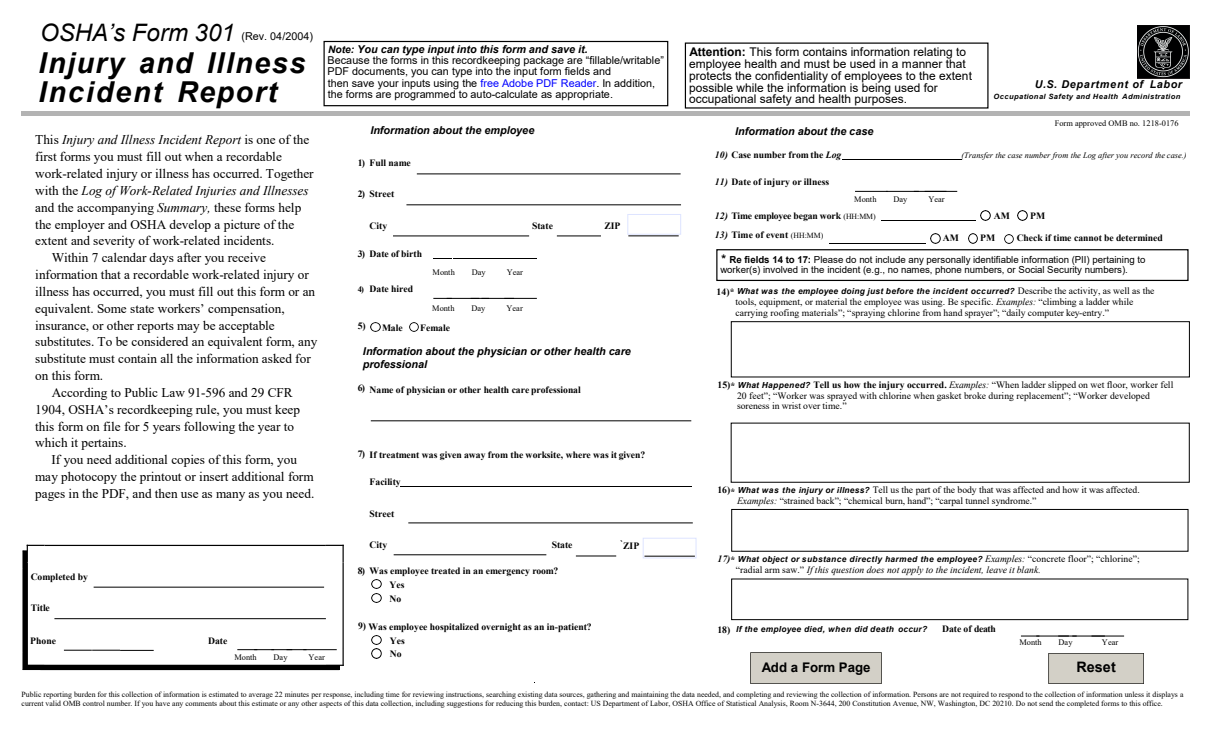
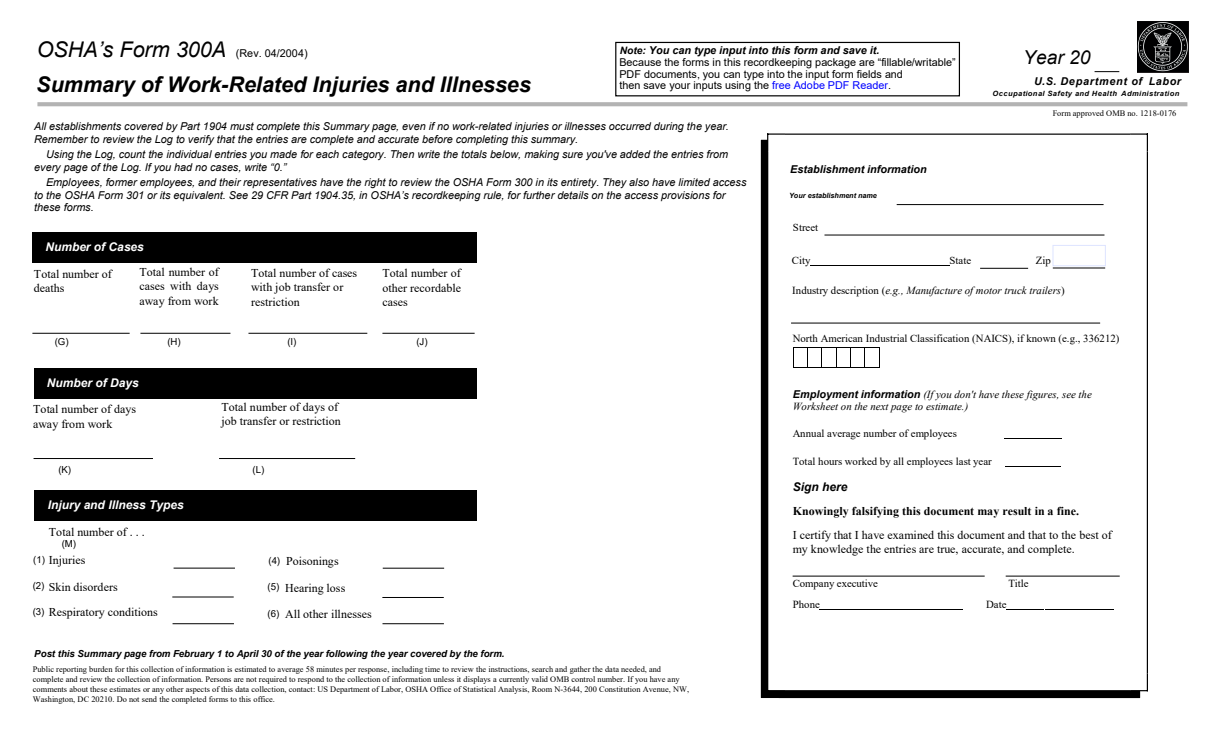
Open OSHA’s current recordkeeping forms ↗ (opens in a new tab)
Move from urgent response to the annual record
- Check urgent reporting first. Under federal rules, report a work-related fatality within 8 hours and a reportable in-patient hospitalization, amputation, or loss of an eye within 24 hours. The fatality must occur within 30 days of the incident; the other outcomes within 24 hours. If the outcome or its work relationship becomes known later, the applicable reporting period runs from when the employer or any employer agent learns the relevant information. In-patient hospitalization means formal admission for care or treatment, not observation or diagnostic testing alone. Check federal transportation exceptions and state-plan requirements immediately. If the Area Office is closed, use OSHA’s central reporting number or online application; voicemail, fax, or email to the closed office does not satisfy this route.
- Confirm coverage correctly. The federal small-employer partial exemption uses the entire company’s count, not one location. Industry exemptions and electronic-submission criteria are assessed at the establishment level. A partial exemption does not remove severe-event reporting duties. Check for a written OSHA or BLS request: an exemption does not excuse records or submissions specifically required by that request, and the request’s deadline must be assigned separately from ordinary annual deadlines.
- Assess and record the case. Document work relationship and criteria. Record a recordable case on Forms 300 and 301, or permitted equivalents, within seven calendar days after receiving information that it occurred.
- Protect privacy cases. Use the confidential identifying list required by the privacy-case rule, limit access, keep only minimum-necessary medical or incident information, and distinguish public posting from authorized record access.
- Close and post the year. When required, have an authorized company executive certify Form 300A and post it February 1 through April 30 of the following year, including a zero-case summary when required. Do not post Forms 300 or 301 in place of the summary.
- Assess electronic submission separately. Determine whether Form 300A or designated Form 300/301 data are due through the ITA; covered annual submissions are generally due March 2 of the following year.
- Retain and update. Retain required records, including any privacy-case list, for five years following the end of the calendar year they cover, and update stored Form 300 Logs as required.
Illustration: one incident can create separate tracks
Illustration only—not a determination for a particular incident or establishment. A work-related in-patient hospitalization may require rapid reporting to OSHA and may also require an ordinary recordability analysis and case records. Completing one track does not complete the other. State-plan rules and the specific facts can change the result, so use the current reporting and recordkeeping sources.
Decide
Applicability questions
- Is the employer or establishment covered based on size and industry, or does an exemption apply?
- Is the case work-related and does it meet a recording criterion?
- Does the case involve privacy-sensitive information requiring special handling?
- Which establishment owns the record when employees work across locations or remotely?
- Does the establishment have a 300A posting obligation, an electronic-submission obligation, or both?
- Does a state-plan jurisdiction impose a different or additional requirement?
Action and ownership
Safety or HR owner
Evaluate recordability, complete the log and incident record promptly, protect confidential information, and maintain an auditable case file.
Annual reviewer
Verify totals, secure required certification, manage the posting period, determine electronic-submission coverage, and retain the records.
Keep as evidence
Evidence to retain
- Forms 300, 300A, and 301 or permitted equivalents for each covered establishment.
- The recordability analysis and minimum necessary supporting incident information.
- Urgent-report confirmation, annual certification, posting, and electronic-submission evidence when applicable.
- Corrections, restricted privacy-case list references, access ownership, and five-year retention controls.
Keep medical and identifying records in approved restricted systems and link by reference; do not duplicate them in general task notes, feedback, screenshots, or posted summaries.
What completion looks like
Incident stage: required immediate reports and case records are completed and evidenced; privacy-case identifying information is kept on a separate confidential list, and the Form 300 entry uses the permitted privacy-case handling.
Annual stage: certification, posting, electronic submission, and retention each have an owner, applicable deadline, and completion evidence when due. Assigning a future task does not complete the legal obligation.
Authoritative sources
- OSHA recordkeeping forms (opens in a new tab)
- OSHA recording and coverage overview (opens in a new tab)
- OSHA Injury Tracking Application (opens in a new tab)
- OSHA severe-incident reporting (opens in a new tab)
- 29 CFR 1904.29 — Forms (opens in a new tab)
Confirm current federal or state-plan rules, establishment facts, source dates, and case-specific information before acting.
Escalate
When to escalate
Escalate when coverage or recordability is uncertain, a fatality or severe incident may require rapid reporting, a privacy concern exists, a citation or inspection occurs, or state-plan requirements may differ.
Boundary
What this guide does not cover
This guide does not decide whether a particular event is recordable, determine coverage for a specific establishment, address workers’ compensation, or replace current federal or state-plan OSHA requirements.
Help us improve
Did this help you complete the task?
Choose an answer for this page, or email only the article ID and a nonsensitive description. Do not send forms, identity documents, payroll or bank data, medical or incident records, passwords, or payment information.
Your choice is selected on this page. To send feedback, use the email link.